Showing posts with label liberty. Show all posts

Wednesday, June 04, 2025

Governing the Commons, Elinor Ostrom

I found Elinor Ostrom's Governing the Commons
to be quite readable and very enjoyable. This book was published in 1990; Ostrom won the Nobel Prize in 2009.

Governing the Commons presents several case studies, and a framework for analyzing situations in which people share access to what she calls a "Common Pool Resource", and find or don't find ways to share equitable access to the resource peacefully and over a long time period. One of her goals is to show that Garret Hardin's idea of the tragedy of the commons is not as ubiquitous as many have believed. Ostrom found and discussed cases where fishermen shared productive access to fisheries, farmers found ways to share access to irrigation water, and herders divided up access to unfenced grazing land. She then presents a framework to analyze what factors made it more or less likely that these cooperative arrangements would be stable over the long term.

The case studies include a few incidents where the arrangements failed or were never brought into existence. She analyzes these in order to trace the causes to lack of coordination, insufficient ability of the participants to monitor each other's behavior, or external interference from governmental bodies (either corrupt officials violating the norms that had been established, or a simple failure to provide sufficent facilities for negotiation.)

I like Ostrom's approach and her way of thinking about these situations. She studied cases where the allocation of resources among participants were mostly monitored and policed by the users of the resources themselves. In a few cases, the government facilitatated the creation of the agreements, or endorsed the approach, but mostly it was up to the users to maintain and evolve their institutions as conditions changed.

One of her strong conclusions is that governments are seldom willing to let a local group manage a local resource in an ideosyncratic way, but broad rules that are applied over varying terrain, social situations, and groups with differing abilities to monitor their neighbors' behavior are seldom workable and stable. General rules leave too much leeway for outsiders to exploit loopholes. Once use of a resource isn't limited to people who know each other, agree on the rules, and know that their grandparents followed the same rules, and expect their grandchildren to do the same, then the self-reinforcing incentive structure will often break down.

Ostrom presents detailed studies of shared access to grazing and timber land in Switzerland and Japan, communally maintained aquaducts in Spain and the Philippines, access to aquifers in the L.A. basin, and shared use of fishery resources in Turkey, Sri Lanka, and Nova Scotia. Based on these case studies, her framework proposes that in order to be successful, a multi-party agreement governing shared access to a renewable, but depletable resource must allow for clearly defined boundaries (in time or space), communal monitoring, graduated sanctions, and a transparent conflict resolution mechanism.

She gives examples of both fisheries and water distribution arrangements where participants had assigned timeslots. These don't require centralized monitoring, because at each transition, the following user ensures that the predecessor turns things over on time. Since there are sanctions and either self-enforced or socially-backed enforcement, people nearly always transition promptly, and accept the punishment if they are somewhat late. Since all the users of the resource know each other and share long-standing social bonds, occasional violations due to exigent circumstances can be overlooked or lightly punished. Everyone in the community finds out what happened, so repeat offenders can be punished more harshly and monitored more carefully.

In Nova Scotia, an arrangement that had worked solidly for generations fell due to the national government's insistence on a uniform solution that didn't account for local differences. The end result was that outside fishermen could encroach, and weren't subject to the local sanctions, so the feedback mechanisms that had reduced usage in the past didn't constrain the outsiders, with the result that even the locals stopped respecting the rules. The local fishery collapsed, and it took years to convince the national government to allow some local control, and more years before the fish recovered and could be productively fished again.

I also reviewed Ostrom's Understanding Institutional Diversity, which is based on this and much of Ostrom's other work. It presents a general framework for analyzing the kind of institutions investigated in the fieldwork in Governing the Commons.

Robert Ellickson's Order without Law covers similar ground, but focuses on a situation where the rules about who is responsible for damage to neighbors' property varies from place to place. In that situation, Ellickson found that when people were part of a community, they could adapt their behavior to local conditions and not be bound by what the law prescribed. It's also a kind of spontaneous order, but the spontaneity is constrained by the governing context. It's also worth comparing Ostrom's work to James C. Scott's work (Seeing like a State, and The Art of Not Being Governed). Scott's focus is on ways that governments get in the way of local control and organization and how that iterferes with people's natural ability to organize and govern themselves.

Saturday, December 21, 2019

Frederick Douglass: Self-made Man, by Tim Sandefur

Timothy Sandefur's Frederick Douglass: Self-Made Man is an inspirational read. Sandefur does a masterful job of putting the story of Douglass' life and accomplishments into context. Douglass was born a slave, and became one of the most prominent abolitionist leaders. He insisted on telling his own story, and led the faction that was most interested in integration. While the leading faction when he started advocating freedom was arguing that the constitution was an impediment to freedom for blacks, he argued that it would be better to take the constitution literally, and use it as the basis for a moral case for equality.

I heard Sandefur give a wonderful talk about Douglass' life at Reason Weekend. (There's an earlier version of the talk on YouTube.) Both the talk and the book deliver a powerful pro-liberty statement and show how Douglass lived as a model of what he advocated, and convinced many other people that playing on the positive vision of the founders would be a more productive way to engage on the issue of emancipation. Douglass trumpeted that "the Consitution is a GLORIOUS LIBERTY DOCUMENT". Douglass argued that the Supreme Court is bound to follow the words of the Consitution rather than historical precedent, and there's nothing in the words that allows or supports treating some citizens as second class. It took a long time before the Supreme Court agreed, but eventually, the aspirational message of the constitution's meaning prevailed.

While I was in the DC area for Thanksgiving, we visited the Smithsonian's African American Museum, since the lines were finally short enough (during the week) that we could get in without reservations. While the historical section of the museum is arranged chronologically, it didn't feel like the museum did a good job of connecting the exhibits to give a feeling of how different incidents connected together. I was glad I was reading a history of the period for context. The museum's exhibits confirmed that Douglass was a prominent leader, though (not surprisingly) they didn't say much about the content of his views, or how much contention there was among different factions of the movement.

I enjoyed the book and recommend it.

Tuesday, December 10, 2019

Two by C. J. Cherryh

I was recently reading Alliance Rising by C. J. Cherryh and Jane S. Fancher and Defender by C. J. Cherryh at the same time. (It's not unusual for me to be reading 4 or 5 books at the same time. Some I have as hard copies by the bed, some on my tablet, and others on my phone.) I've liked most of the Cherryh that I've read, so I was a little surprised at my reaction to these two.

Defender is book 5 in a 20 book series, and I enjoyed it a lot. I'm familiar with the characters, and there's a lot of action, and many factions jockeying for control. It doesn't have much of a pro-liberty message -- I don't insist on that in everything I read.

Defender focuses more on a struggle to keep the peace, and a society where some of the characters have very alien motivations. This is one of the things that I like about this series--Cherryh has a really great ability to depict people who don't think as we do.

My response to Alliance Rising, was quite different. If it hadn't been nominated for this year's Prometheus award (I'm on the review committee) I might even have set it aside. After getting through about a third of the book, I felt like the only actual action that had taken place was that an unexpected ship had arrived at the space station where the story takes place. The rest was all talk. There had been meetings and trysts and discussions and a lot of description of historical and political background by the authors. By the end there was a little more action, but the focus was really on politics and lobbying.

But I have to admit that Alliance Rising is a plausible candidate for the award. The politics and hobnobbing are all in service of the independent trading ships banding together in the face of Earth's apparent intent to take over the interstellar shipping business. There are safety concerns because the people acting for Earth's government are more concerned with controlling commerce than operating a business, while the traders have family ties with the stations, and have an interest in making sure that trade continues even where it's uneconomical at times. I'm not sure that it's a principaled pro-freedom message, but it's at least plausible. I still prefer to read SF stories where the plot is advanced by stuff happening, rather than by people talking. I'll have to wait to see how this book stacks up against the other contenders for this year's Prometheus.

Monday, July 03, 2017

Seeing Like a State, James C. Scott

I found a lot to like in James C. Scott's Seeing Like a State. It presents a way of thinking about the consequences of governments' interventions that makes a large category of unintended side effects appear coherent. Once you see this consistency, you can make predictions about other interventions and the ways they will turn out without needing to ascribe motivation to the planners behind them. In order to achieve their goals, bureaucrats and autocrats have to make the population they intend to help more surveyable, visible, and regular. That very act, independent of how much the rest of the change might be done with the best interests of the people in mind, reduces the relevance of the local knowledge and expertise that they have built up over time, making them more dependent on government, and less able to fill in the gaps in the ways that lead to smoothly functioning societies.

Scott describes several grand schemes, mostly done to help various populations, though often in ignorance of the ways of the people living in the affected area. He discusses state-sponsored forestry, Corbusier's city planning, government-sponsored (and private) experiments in industrial agriculture, China's Great Leap Forward, resettlements in Tanzania, as well as touching on other examples. In each case he shows how the (necessarily) high level plans of of the top officials were translated into concrete details for the convenience of those implementing the plan, in ignorance of the deleterious consequences for the affected villagers. The end result in each case conformed to the planners' specifications, but left an unlivable environment in which the inhabitants were more dependent on the government, and often much poorer than they started out.

Whether the results of all these grand schemes ended up being helpful is questionable, and is certainly independent of what the original intent was, or how much effort was spent during the planning stage in considering ways to make the outcome closer to what the subjects would have asked for. Since plans and maps are necessarily abstractions from reality, and since the plans must be carried out by intermediaries whose interests are distinct from both the rulers and the people being 'helped', those doing the work will have to have to fill in details about how to get the work done. This will often be done in ignorance of the intent, and more usually without concern for the extended well-being of the future of the community.

As with Jacobs' Death and Life of Great American Cities, the point isn't to move towards a conclusion on how to do a better job of redesigning a society, so much as of having skepticism that it's possible to achieve humane objectives by trying. In most cases, hubris would lead to addressing problems by allowing people to adjust things in an incremental manner. Otherwise we risk replacing things that seems suboptimal to an outsider with situations that are truly dismal for those left behind. While discussing Soviet collective farms, Scott talks about some attempts by American industrial agricultural firms to do something similar in the midwest. Their grand plans for integrated industrial farms didn't succeed any better, but the difference was that when the outcome became clear, the companies involved backed off and the land reverted to more local, context-sensitive control.

Sunday, September 21, 2014

License to Work

The Institute for Justice has a new study out comparing the onerous regulations each state puts on entry to various occupations. In the past, they've focused on occupations that are pretty clearly not safety related, so people would see that the goal is fire-walling existing jobs rather than protecting the public. This study focusses on occupations that are favorable to low and medium income people—that is, on entry-level jobs. They've won several cases on occupational freedom for flower arrangers, interior decorators, and tour guides as a few examples.
The tremendous variation between states in how much training, and in the exams required makes it clear that there's no consensus on curriculum and no common core of knowledge across states. By the way, California come out as having the second most onerous licensing regime. People who care about making it easier for low income people to get started should find it easy to oppose California's extensive regulations on everything from landscapers to makeup artists.
Another point that I think IJ ought to make more explicitly is that the public should distrust arguments based on the jobs that would be protected. I think it's commonly the case that entrenched interests easily get popular support by talking about their members who will lose their jobs if some new approach is allowed. IJ's ads should remind us that whenever entrenched interests are able to erect barriers to entry, it means higher prices and less innovation. This applies to restaurants fighting food trucks, teachers fighting charter schools, and taxi cartels fighting new transportation models (Uber and self-driving cars). In each case, we can easily see the incumbents who might lose their jobs, but locking in the existing model means less innovation, and fewer chances to discover more effective ways of teaching, more efficient uses of our roads and ways to reduce the number of cars required, and a larger variety of food and more convenient places to eat.

Sunday, February 09, 2014

The Righteous Mind, by Jonathan Haidt

Jonathan Haidt's The Righteous Mind argues that our political leanings are strongly tied to our moral intuitions, and explains that people in each of the main political categories have different fundamental tenets that they each believe in strongly. There's some overlap between the various groups, but Haidt presents evidence that there's a lot of consistency within each group. If you hope to convince people on the opposite side of these divides of anything important, it's crucial to understand the foundations their reasoning is based on. If you believe the people you argue with are confused or evil, rather than reasoning from different premises, your arguments will fail to sway them.

In part one, Righteous Mind argues that intuition comes first, and strategic reasoning second. People enter a discussion of morality with instincts that tell them the answers. Most of the arguments they make are driven by their instincts, and little follows from intellectual considerations. Haidt relies heavily on the metaphor of a rider on an elephant. It's possible for the rider to decide which direction they go, but the elephant makes the first choice, and the driver has to convince the elephant if they're to end up somewhere else.

The second part covers the common foundations of our moral instincts. Most philosophers have concluded that morality is based on fairness or avoidance of harm. Haidt's research has shown that across cultures, there are actually six relatively consistent value frameworks that different political camps choose among. He says "The righteous mind is like a tongue with six taste receptors."

The third part shows that common feelings about morality bind communities together and blinds members of those communities to the goals, tastes, and priorities of their neighbors. He argues that religion evolved because of its contribution to social cohesion in contrast to the common atheist accusation that it's mostly religion is a memetic parasite that wins at the cost of its carriers.

Haidt is a master at presenting short vignettes that adherents to one viewpoint will say shows immoral behavior and others will be fine with. Whatever your outlook, he knows some stories that your group will be the only one to approve of, and other stories that you'll find to be disturbing while people with other political views won't be bothered. This technique seems to have been the core of the research underlying the book. He uses it to good effect in teasing apart the most basic drivers of people's instincts about right and wrong.

The underlying drives presented in the book. The names represent virtues and the adaptive challenge in the evolutionary environment that they protected us from. Haidt often refers to them just by the name of the virtue, and so will I.

  • care/harm
  • fairness/cheating
  • liberty/oppression
  • loyalty/betrayal
  • authority/subversion
  • sanctity/degradation
Liberals rely on caring, then fairness and liberty. Conservatives rely on all six, somewhat equally. Libertarians rely most on liberty, and a little on fairness. On the left, fairness often implies equality, but on the right it means proportionality—people should be rewarded in proportion to what they contribute, even if that guarantees unequal outcomes. Liberals also have a streak of sanctity, but it usually applies to nature and cleanliness rather than religious faith. Notice that there is no foundation used by the left that is not also important to the right. Liberals reject altogether some of the values that matter to Conservatives. To Liberals, loyalty and respect for authority can be outright negatives.

If you have trouble seeing how virtues other than the ones you believe in can be seen as fundamental, you're going to miss most of the point of the book.

When Haidt's research team asked liberals and conservatives to predict one another's responses to his Moral Foundations survey, they found that conservatives were the best able to understand other's motivations. Liberals seem to assume that where others hold values more weakly than liberals do (because there are other values they hold more strongly) that those with whom they disagree hold the opposite position from them rather than understanding that value but having another, higher priority. Many Liberals, when asked to describe Conservative values, say that they are actively pursuing evil ends. Conservatives, since they use all 6 metrics, can recognize when others are relying on particular values. Libertarians are most handicapped by this standard (having only one prime value), but their advantage is that, being in the minority, they are more used to talking to people with different points of view.

Part three of the book argues first, that humans are uniquely social creatures (He cites Tomasello, an expert on chimpanzee cognition, who said "It is inconceivable that you would ever see two chimpanzees carrying a log together.") Bees and ants sacrifice themselves for the hive, but individual cooperation is extremely rare if you exclude sex and other instinctive behavior. Second, that religion is mostly used to bind us into communities. He argues that we have a built-in "hive switch" that makes us bind more tightly and unthinkingly into groups. The release of oxytocin binds people to their groups, not to humanity as a whole. Finally, he argues that the New Atheists (Dennett, Dawkins, and Harris, primarily) miss the main point of religion, which is to bind people into groups. The fact that they naturally divide everyone into insider and enemy is a consequence of human psychology. The rituals "that the New Atheists dismiss as costly, inefficient, and irrational turn out to be a solution to one of the hardest problems human [societies] face: cooperation without kinship." Haidt uses these points to support his conclusion that treating people who disagree with us (or merely act differently) as repugnant is a deep-seated reaction.

Haidt says he grew up a liberal, and it was partly due to his studies of different political approaches that led him to a conservative viewpoint. It was also as a result of his studies that he came to see that libertarians have a distinct approach that is straightforward to describe in his framework. The descriptions of the liberal progress narrative (a quote from Christian Smith's Moral, Believing Animals) and the conservative mindset (a description of the "Reagan narrative" from Westen's The Political Brain) are masterful in their contrasts. Smith wrote

Once upon a time, the vast majority of human persons suffered in societies and social institutions that were unjust, unhealthy, repressive, and oppressive. These traditional societies were reprehensible because of their deep-rooted inequality, exploitation, and irrational traditionalism…But the noble human aspiration for autonomy, equality, and prosperity struggled mightily against the forces of misery and oppression, and eventually succeeded in establishing modern, liberal, democratic, capitalist, welfare societies. While modern social conditions hold the potential to maximize the individual freedom and pleasure of all, there is much work to be done to dismantle the powerful vestiges of inequality, exploitations, and repression.
Westen's description is
Once upon a time, America was a shining beacon. Then liberals came along and erected an enormous federal bureaucracy that handcuffed the invisible hand of the free market. They subverted our traditional American values and opposed God and Faith at every step of the way. … Instead of requiring that people work for a living, they siphoned money from hardworking Americans and gave it to Cadillac-driving drug addicts and welfare queens. Instead of punishing criminals, they tried to "understand" them. Instead of worrying about the victims of crime, they worried about the rights of criminals, … Instead of adhering to traditional American values of family, fidelity, and personal responsibility, they preached promiscuity, premarital sex, and the gay lifestyle … and they encouraged a feminist agenda that undermined traditional family roles. … Instead of projecting strength to those who would do evil around the world, they cut military budgets, disrespected our soldiers in uniform, burned our flag, and chose negotiation and multilateralism.
Haidt points out that these are very much descriptions of the American liberal and conservative viewpoints. In other countries, the narrative would be different, and in some, the constellation of values wouldn't align the same way. But in all the countries he's studied, the same 6 underlying values keep coming up in different combinations, and his story problems elicit the same distinctions, when adjusted for local customs and unique traditions.

Haidt believes that the crucial value that liberals misunderstand is moral capital (he's careful to draw a distinction from social capital). He cites Bertrand Russell to make the point: "Every community is exposed to two opposite dangers: ossification through too much discipline and reverence of tradition, on the one hand; on the other hand, dissolution, or subjection to foreign conquest, through the growth of an individualism and personal independence that makes cooperation impossible." Haidt then says

If you are trying to change an organization or a society and you do not consider the effects of your changes on moral capital, you're asking for trouble. This, I believe, is the fundamental blind spot of the left. It explains why liberal reforms so often backfire, and why communist revolutions usually end up in despotism. It is the reason I believe that liberalism—which has done so much to bring about freedom and equal opportunity—is not sufficient as a governing philosophy. It tends to overreach, change too many things too quickly, and reduce the stock of moral capital inadvertently. Conversely, while conservatives do a better job of preserving moral capital, they often fail to notice certain classes of victims, fail to limit the predations of certain powerful interests, and fail to see the need to change or update institutions as times change.

I found this to be a very helpful book, explaining how different factions see the world, and it's presented in a way that's sympathetic to everyone's views. If you want to argue constructively with people it helps tremendously to be able to understand where they're coming from. Having more of an understanding of other points of view also makes it much easier to hear what someone else's concerns are so you can address those directly. When we misunderstand one another we often talk past one another, not realizing that the other party has different values, rather than misunderstanding our position. Too much of politics today is based on ascribing bad motives to the opposition.

Saturday, May 25, 2013

Actively Disengaged

I just came across a new webcomic, Actively Disengaged that I thought was hilarious. If you're a libertarian, anarchist, voluntarist, or know many people who are, you might like it too.

They apparently publish weekly, and have 70 back comics, so they've been around for a little over a year. I read through the entire set, and laughed, chortled, and grimaced. The art isn't very sophisticated, but the humor is biting.

The ad I clicked on was at Day by Day, which also knows what libertarianism is, and is often sympathetic. If you are wary of nudity, this one won't be for you.  DBD comes out daily, and often reacts to the previous day's news. I often click on the ads at DBD, though not many of the comics stick in my daily reading list.

Sunday, April 29, 2012

A Connecticut Yankee in King Arthur's Court, Mark Twain

Mark Twain's A Connecticut Yankee in King Arthur's Court was a joyous discovery for me. I have long been aware of the story, but didn't have any expectations about it beyond what's obvious from the title. When I started reading it, I discovered that Twain used a simple scenario to explore problems of government and to illustrate freedom's benefits over coercion. Twain's penchant for stories celebrating individual endeavor drives this story.

The Connecticut Yankee is Hank Morgan, a blacksmith and horse doctor, who gets knocked out in a fight and awakens in King Arthur's England. Morgan quickly realizes that with his "modern" knowledge, he can do things the people around him won't understand, and he can use this to gain power that he can use to accelerate progress and bring about an early renaissance. Morgan's concerns are education, sanitation, and preparing the people for democracy. It doesn't take him long to figure out that they aren't ready, but he maintains his confidence that it's only a matter of time and education. He is convinced that once they come to see that the nobles are people, too that they'll be willing and able to govern themselves. In the end, he decides that it isn't the people who are the obstacle, but the hereditary aristocracy who can't learn that they aren't different. I suspect Twain was insinuating that the government of his day was composed of people who thought they were naturally suited to manage other people's lives.

Morgan starts out by gaining King Arthur's trust by recognizing the date of his scheduled execution at the court of King Arthur as the day of a lunar eclipse, and pretending to be a mighty wizard (in competition with Merlin) who can control the Sun. Once he has access to Arthur, he uses his understanding of modern science and manufacturing techniques to develop tools and processes that give him real powers to do things none around him know how to do. He then sets about reforming the country by vanquishing individual knights and setting them to tasks like promoting the use of soap that will completely remake society.

Along the way Morgan has to battle superstition, lack of critical thinking, learned helplessness, and many other obstacles. He builds a corps of youngsters who attend his secret schools and man his secret factories to turn out a long list of products that will improve people's lives.

The story is by modern standards closer to fantasy than science fiction, but Twain clearly intended to make the technology development plausible. There are times when his hero takes shortcuts that modern understanding makes obvious, but were probably less clear in Twain's time. For instance, Morgan's first miracle after calling the eclipse is to blow up Merlin's tower, for which he needs dynamite and wire. Twain assumes that making some wire could be done in a couple of weeks starting from scratch, but it without the infrastructure of a manufacturing economy even something so simple would be a lot more work.

I found this a remarkably enjoyable read, and was surprised that Twain covered so much territory. If you can get past the dated prose and Twain's conceit that a single person could manage such a vast enterprise with help only from people who have no concept of the idea of individual initiative, you'll probably enjoy it, too.

Sunday, April 15, 2012

Ready Player One: Ernest Cline

Ernest Cline's Ready Player One takes place mostly inside a virtual reality/MMORPG, though as usual with the recent spate of books in this genre, the action bleeds back and forth with physical reality. The setting is pretty familiar: it's 2044, and the economy has bifurcated into haves and have-nots, and most people seem to spend the bulk of their time in the OASIS. James Halliday, the billionaire founder of the company that runs the OASIS has died, and has set up a contest inside the system that will determine who gets his company shares, his wealth, and control of the OASIS itself. It turns out Halliday was hugely into eighties trivia, and most of the story involves the main character, Parzival, and his on-line friends finding and devouring movie, music, video game, and science fiction trivia from that decade. If you're not averse to geeking out on this stuff, it's a fun romp.

Parzival is the first to find the Copper key, the first step on the quest that Halliday built. Others soon figure out how to backtrack on Parzival's location which gives them the clues they need to follow on his trail. This starts a race to complete the quest and beat Innovative Online Industries, a company that wants to win the contest in order to exploit OASIS's business possibilities. The action is fast-paced, the settings are widely varied, and I enjoyed the references to familiar games, movies, and bands. The character development is fairly shallow, with Parzival maintaining a close friendship with one fellow gamer and a crush on a female-named character that lasts throughout the story. He's convinced he knows that it's someone he could love in real life, and never takes seriously the idea that people can have very different personalities and appearance than their avatars.

Ready Player One is a finalist for this year's Prometheus Award, but I don't think it's a very strong contender. The major element of libertarianism is that the central struggle is over whether the game's virtual world will be under the control of the main character and his friends or the bad guys. If you think the OASIS will be all the reality that matters to most of its denizens, you might want to cast that as a struggle over governance. But the choice isn't between any kind of freedom and some kind of authoritarianism, it's between a faction that has one particular corporatist view of how things should be run, and another that has no explicit goals other than keeping the VR out of their control. No mechanism is suggested for preventing the games' owner from doing whatever he wants. Maybe that's a libertarian outcome, in that it's private property, but that's not what the story's struggle is about.

The science fiction element in this story, like a lot of this genre, is thin. The particular capabilities of the VR software are beyond what we can do today, but not very far. The economy and society depicted outside the OASIS aren't a straight-line extrapolation from today, but they bear a strong resemblance to what some mild pessimists seem to expect. It fits the criterion mostly by being the kind of story that members of the LFS would be likely to read and appreciate.

If you like that kind of thing, it's fairly well done, and worth the read.

Saturday, August 12, 2006

Moral intuitions

I followed a pointer provided by Tyler Cowen, and read an interesting paper ("When morality opposes justice: Conservatives have moral intuitions that liberals may not recognize") by Haidt and Graham on the moral intuitions of Liberals and Conservatives. The writers are apparently liberal academics, and they explicitly address their predominately liberal colleagues in an explanation of how liberals and conservatives differ in their views on morality. There is no mention of libertarians, but I think I can tease out a comparison that includes us. If someone knows of a similar approach that has been prepared or presented more carefully, I'd appreciate a pointer. I also welcome discussion of whether what I say seems roughly true to other libertarians.

The main claim in this paper is that there are consistent standard bases for moral reasoning used by liberals and by conservatives, and they're not the same. Haidt & Graham point to a long literature on the subject, mostly written by liberals, so it emphasises the liberal ethos, but there are other papers that explain how the conservatives fit in. The basic idea is that liberals take equality or reciprocity ("justice/rights/fairness") and compassion ("harm/welfare/care") as the only significant concerns. Conservatives, according to the argument, have three additional foundations, which he calls ingroup, hierarchy, and purity. Ingroup treats the group you are a member of as a moral end in itself; hierarchy says that deference to authority (usually hierarchical) is a moral fundamental, and purity treats our attitudes of disgust (toward people who behave differently, bodily fluids, or evidence of decay) as a moral indicator. They talk about evidence showing these attitudes are common and correlated with political attitudes.

Here are examples of the type of questions used to distinguish each concern in an on-line survey:

  • Whether or not someone was harmed [harm foundation]
  • Whether or not someone acted unfairly [reciprocity]
  • Whether or not someone betrayed his or her group [ingroup]
  • Whether or not the people involved were of the same rank [hierarchy]
  • Whether or not someone did something disgusting [purity].

The paper presents an evolutionary scenario to show how the 5 foundations could have evolved, and explains that people who adhere to all five foundations (fundamentalists) are more common than those who follow just the two liberal tenets. The explanation they profer is that the larger list arose over an evolutionary time scale while modern liberalism is a result of more recent forces that they didn't identify. The three conservative-only bases make sense in the evolutionary environment. The liberal foundations have been presented before as part of Maslow's hierarchy of needs or Kohlberg's stages .

I think libertarians believe strongly in justice and fairness, but the emphasis is quite different from liberals: for libertarians, the point is equal treatment, while for liberals, it more often equates to equality of outcome. I wouldn't have included "reciprocity" in that constellation. And libertarians view compassion as a personal virtue or preference, rather than something for which you fault others. Compassion is much less a driver of fundamental moral insights for libertarians as long as justice and rights are respected.

The causes Haidt and Graham suggest for the shrinking list of moral concerns of modern liberals also makes sense for libertarians:

the growth of free markets, social mobility, science, material wealth, and ethnic and religious diversity. Mobility and diversity make a morality based on shared valuation of traditions and institutions quite difficult.

I'm not sure what to add to their story to explain the difference between libertarians and liberals.

Thursday, January 26, 2006

Fight Eminent Domain Abuse!

The Institute for Justice has announced a new website for their Castle Coalition project to fight eminent domain abuse at the state and local level whereever possible. You can join the Castle Coalition for free. (But why not donate too?) They promise to send regular updates about efforts to combat eminent domain abuse, and tell you about opportunities in your area to fight the land grabbers.

Their web site has information on what to do if you are threatened with Eminent Domain ("we'll only use it as a last resort" is a threat to take your land if you don't agree to their price), where eminent domain cases are active around the nation.

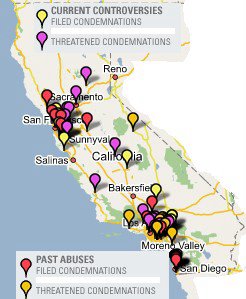
They also have a google map showing where abuses, threats, and events are taking place. Here's the map showing just California. There's a lot going on right here that we could help with. The rest of the country has plenty of reasons to fight back as well.

Filed in: