Sunday, March 05, 2006

David Buller: Adapting Minds

David Buller's 's Adapting Minds was pretty hard to get through, but the most important ideas seemed to have been covered in the first half. I only got about half-way through before skimming and skipping my way through the rest. I got the impression from the reading group's discussion that more people than usual hadn't finished the book.

Buller's goal is to show that the most well known findings of the Evolutionary Psychology movement (which intends to show that there are facets of human behavior that are evolved and universal) result from misinterpretation of the experimental results, or from improper controls in the experiments. In this, it resembles Judith Miller's The Nurture Assumption, which showed that most of the research intended to determine what traits are genetic based on comparisons of twins raised together or apart misunderstood the nature of the correlations they were looking for, and so used the wrong attributes as controls. Miller's book succeeded in demolishing those results, and put forward alternate explanations along with supporting evidence to show that her characterization worked better than the standard interpretation.

Buller succeeds in showing some flaws in the widely touted results, but doesn't present plausible alternative explanations. In the end, the reader is left with the feeling that EP's results have been nitpicked to death, but has no solid basis for guessing which way the experiments would come out if run again with better controls. On the other hand, since Buller started out by saying that he didn't want to attack the idea that there's an evolved basis for behavior, Buller wouldn't count this as a failure. All he wanted to do was shoot down the specific results of the EP proponents, and not the idea of heritable behavioral traits, or the program of research intended to establish the details.

One particular example that Buller beats to death is the Wason Test, the results of which have been widely interpreted to show that people have an innate cheater detection facility. Buller relies on the argument that the form of the two questions that are asked (if even then red, versus if drinking then must be of age) are different kinds of logical propositions. The most enlightening version of the explanation (he seems to explain at least a dozen times, with references to different experts and scholarly lines of discussion) is that the two cases that supposedly violate the given rules differ structurally. In one case, the consequent is negated ("the card shows red"), in the other, the rule's requirement is not complied with ("the patron is under age").

In the end, it seems clear that the EP crowd's explanation doesn't carry all the force it is commonly purported to. At the same time, it's also clear from introspecting on our difference in performance on the two tasks that we solve one by general reasoning, and the other using a built-in problem solver (it's fast, and the process is introspectively atomic). Even if it is the form of the question that affects the results rather than the subject matter of the question, there's still a difference in performance that matches the EPers' description of a behavioral facility that is inate, specific to humans, and universal among healthy individuals. It's an inherited behavioral trait. The boundaries aren't where the standard explanation puts them, put it's still there.

Filed in:

Sunday, February 26, 2006

Charles Stross: The Hidden Family

Charles Stross's Merchant Princes series is rollicking good fun. There's plenty of adventure, invention, conflict, great characters, and the underlying story is about different paths to economic development. I hadn't expected a story with this much economic sense from a purported member of the gang of "New Scottish Socialist SF Writers", but apparently that's more a characterization of who he hangs out with than how he thinks. Even as a follow-up to Accelerando, it's surprising; Accelerando was very full of a sense of property-is-so-last-century.

But on to The Family Trade and The Hidden Family. The first book stands well enough on its own as science fiction. Miriam is a smart journalist working the high-tech sector around Boston who suddenly discovers that she has the ability to travel to an altenate earth. It turns out that she's a long-lost member of a family in which this abilty passes from generation to generation. Miriam's family have set themselves up as medieval lords in this alternate version of North America where the industrial revolution hasn't happened yet, even though they seem to share our history up through at least the early 18th century. The families have paid for their place in society by smuggling hard goods between the worlds. Early on, it was gold and jewels, but currently, the most valuable commodity is illegal drugs. Being able to smuggle around the borders through the alternate world is a very lucrative business, but isn't doing any good for anyone but the families.

In the first book, Miriam learns the lay of the land, and figures out how the family politics work. It's clear at that point that she's figuring out that she doesn't like the smuggling business, or the way women are treated in the families, and she's determined to do something about it. With her background covering the high tech sector, it's obvious that bringing in new ideas and helping the society to progress is on her mind. But the first book ends before she has a chance to really get started. It's still a fun read, but you're definitely left wanting to read the sequel.

And the sequel (The Hidden Family) lives up to the expectations built by the first book. Miriam discovers another world and a lost branch of the family, and builds a company and a personal empire by importing new technology. Her goal is not just to build a power base, but to do so in a way that accelerates development of technology in the two new worlds she has access to. She shows the families that ideas are more valuable trade goods than the most valuable commodities, and manages to start two worlds on a path to modernization that should eventually free up many hands and allow many more people to get away from back-breaking manual labor and start contributing to progress and abundance.

Miriam does a great job of making it clear that progress is beneficial to all, and even if she's going to make herself wealthy by following this path, she'll need plenty of help, and those who ally themselves with her will probably be able to make themselves rich as well, while raising the standard of living of all those around them.

I loved the sense of life in these books; the vision of progress; and the distaste for rigid, controlling approaches to enterprise. The female lead and her strong female support group was very refreshing. They had to survive physical trials, fight armed attackers, avoid booby-traps and ambushes, and negotiate the distractions of love. Most of those fighting to stop Miriam were male, and most of the women were supportive, but certainly not uniformly so in either case.

This is the strongest candidate I've read so far this year for the Prometheus award. It's very well written, very engaging, and I really liked Miriam's approach to addressing her problems.

Sunday, February 19, 2006

Coverville, podcast

I started listening recently to Coverville, a podcast of cover songs. I think I like it for the same reason I listen to the Norman Bates Memorial Soundtrack Show on KFJC, a local college radio station. Robert Emmett, the host, plays soundtracks, show tunes, TV theme songs, old commercials, and a variety of familiar material.

I just listened to Coverville's Groundhog Day show, and it's pretty funny. In an homage to the Bill Murray movie, Brian Ibbott plays a cover by the Chapin Sisters of Britney Spears' song Toxic, the plays another Britney Spears cover Baby One More Time, then replays the show's introduction, and a different cover of Toxic, a second cover of Baby One More Time by Nicotine, this time. This is of course, followed by the show's introduction and a third rendition of Toxic. He closes with Max Raabe covering Oops, I did it Again by Britney Spears, and UB40 and Chrissie Hynde covering I Got You Babe.

He did indeed get me. I checked my ipod each time he repeated the introduction to ensure I hadn't bumped it.

I like this podcast because the music is good, and Ibbott does a good job introducing the songs and the performers.

Filed in:

Tuesday, February 14, 2006

Choosing the right Words: Flows to Bay

I like it when someone finds the right words to convey a message.

In most of the Bay area, the storm drains are stenciled with messages that say "No dumping, flows to Bay", or "No dumping, flows to Stevens Creek", identifying the particular local waterway that leads to the Bay or Ocean. In other places around the country I usually see "No dumping, drains to river." Since I moved to the Bay Area, it has always seemed to me that the word "flows" was much more persuasive than "drains". "Flows" immediately makes the storm drain system feel like part of a living waterway, while "drains" leaves people with their inchoate feelings that whatever is flushed down will somehow be treated before it re-emerges.

And adding the identity of the destination makes the message even clearer. Whatever you put in here will emerge not very far downstream among your neighbors.

BTW, Google finds 537 referents for "drains to river", vs. 209 for "flows to river".

Friday, February 10, 2006

There is no God

There are lots of reasons to like Penn Jillette, but today I point only to his entry (from November) in NPR's "This I Believe" series. The vocal half of Penn and Teller tells us forthrightly of his positive belief in the lack of a deity, and the positive things that remain to honor and cherish. He manages to pack an enormous amount of value into a short statement. Without God, there are still reasons (reasons we create for ourselves) to enjoy life and treat people right. Believing there is no god means we have to take responsibility for ourselves, and leaves us out of the shadow of an omnipotent who could prevent our suffering but doesn't and doesn't explain why in any plausible way. Isn't that a liberating thought?

I, too, believe there is no god.

Wednesday, February 08, 2006

The World is Flat, by Thomas Friedman

I really enjoyed Thomas Friedman's The World is Flat, even though it's talkative, full of anecdotes, and argues for a point of view I already agree with. Friedman has many useful points to make about globalization, and it seems to me that he makes them in a way that could reach many who are opposed or sceptical if they are exposed to the ideas. The fact that the book is on the bestseller list means that there's a chance that many of these people will hear Friedman's arguments.

Friedman's metaphor is that trade is bringing most of the world closer together, leveling the playing field so everyone can be a supplier to everyone else. The effect of this change is that all businesses are getting more efficient, and delivering better value to customers everywhere. As this continues, everyone with access to the global marketplace is being offered more and better goods and services, and is under constant pressure to use those advances to offer more, better, cheaper, faster services to their customers in turn.

This sometimes leads to companies letting some employees go, or even going out of business as they search for more cost-effective ways to serve customers. But that's only a short-term effect, and everyone benefits from the lower prices and improved quality. So everyone is constantly benefiting from the improvements, and many of us take a turn being inconvenienced. But keeping things the same isn't an option, and hasn't been an option for a long time.

Friedman's point is that the right way to think about the effects of international trade is that trade is good for both parties, and for most of the bystanders as well. It's not always easy to see everyone's gain when something particular that you've grown to rely on changes, but it's there if you look for it. Schumpeter used the term "creative destruction" to describe the way the constantly shifting market is always removing old things in order to bring in new and better approaches.

Friedman includes a fair number of helpful hints for individuals and business leaders trying to find a way to survive the constant changes. Above all, he recommends flexibility. You can't be sure which direction the next change will come from, so you need to keep your ability to learn new skills, and you have to have a cushion so you can survive until you've found your next appropriate strength. Always be looking for ways to enhance your contribution to the global marketplace, because others are doing the same, and they will undercut your current approach in a way you weren't expecting.

I like the way Friedman depicts the entire free world as constantly looking for ways to improve life for everyone. As more people from India, China, Russia, and elsewhere find ways to connect into the global economy, they are all constantly finding ways to provide a new valuable service, or to provide an existing good better, faster or cheaper. As he points out, when communism collapsed in the late eighties, it unleashed 1.5 billion people who each had to do something valuable for someone in order to survive.

He also has constructive ways of thinking about what we lose as we face this constant change. He quotes Michael Sandel as telling him

A flat frictionless world is a mixed blessing. It may be good for global business. But it may also pose a threat to the distinctive places and communities that give us our bearings, that locate us in the world. From the first stirrings of capitalism, people have imagined the possibility of the world as a perfect market — unimpeded by protectionist pressures, disparate legal systems, cultural and linguistic differences, or ideological disagreement. But this vision has always bumped up against the world as it actually is — full of sources of friction and inefficiency. Some obstacles to a frictionless global market are truly sources of waste and lost opportunities. But some of these inefficiencies are institutions, habits, cultures, and traditions that people cherish precisely because they reflect non-market values like social cohesion, religious faith, and national pride. If global markets and new communications technologies flatten those differences, we may lose something important. That is why the debate about capitalism has been, from the very beginning, about which frictions, barriers, and boundaries are mere sources of wasted and inefficiency, and which are sources of identity and belonging that we should try to protect.(italics added)

The flattening international economy isn't something that can be stopped — short of a global holocaust of some sort. Understanding its nature and why it sometimes hurts should make it much easier for people to navigate the constantly changing terrain.

Filed in:

Monday, February 06, 2006

Hibernate mappings are Order-Sensitive

This won't mean much to most of you; I record it here so the search engines will be able to find it. I spent about a half day debugging a new Hibernate mapping (hbm.xml) file I just wrote. Maybe the next person to run into this will see this problem description before they spend that much time.

This is about the tenth mapping file I've written, so I'm starting to feel like I know what I'm doing. I am defining a mapping for an object that holds a Map (Java's Dictionary: look up an Object, indexed by another Object.) In order to store a Map in an RDB, you need columns for the Object holding the Map (to identify the particular Map in the DB), the key, and the value. Once I described the mapping, I got a compilation error. The error message said mainly:

Caused by: org.xml.sax.SAXParseException: The content of element type "map" must match "(meta*,subselect?,cache?,synchronize*, comment?,key,(map-key|composite-map-key| map-key-many-to-many|index|composite-index|index-many-to-many| index-many-to-any),(element|one-to-many|many-to-many| composite-element|many-to-any),loader?,sql-insert?,sql-update?, sql-delete?,sql-delete-all?,filter*)".

I re-read my description several times, read the documentation many time, searched for examples using map-key-many-to-many (found very few), and scratched my head a lot. Finally, I did find a sample use of map-key-many-to-many in a different section of the manual, and wondered whether the order of declaration could possiby matter. That turned out to be the problem. Somehow, I'd been following templates and not consciously noticed that XML documents described by a DTD are order-sensitive. If there's anything in the Hibernate documentation saying that it is order-sensitive, I missed it. If you swap the lines with map-key-many-to-many and many-to-many, it won't work.

<map name="positions" cascade="all" inverse="true">
    <key column="ACCOUNTS_ID"/>
    <map-key-many-to-many class="net.commerce.zocalo.claim.Position" />
    <many-to-many class="Coupons"/>
</map>

You can change the order of elements within a tag, but you can't change the order of the tags. Beware!

Sunday, February 05, 2006

Dangerous Ideas

I've talked about Edge.org before. They had another good end-of-year question to a large group of intelligent folk. I'm only a quarter of the way through reading them, but I have some reactions worth blogging already. I have two to recommendation and one to argue with. If I find more worth remarkign on as I read more, I'll continue with them later.

  • Richard E. Nisbett: Our reports on why we like particular things, why we make particular choices, and what makes us happy are remarkably unreliable. We are not good sources of information on our own behavior and taste. I think this underscores Tyler Cowen's recommendation that we try a variety of experiences.
  • Steven Pinker has said this before: there are genetic differences in average talent and temperament between the races and the sexes. We should stop pretending this isn't so, since it makes it impossible to make immportant distinctions or investigate some (e.g. health-related) differences that should affect our behavior.
  • Mihalyi Csikszentmihalyi proposes that the idea that the free market is (I think he means "ought to be") the ultimate arbiter of political decisions is a dangerous idea. He argues that the problem is that some believe that the free market is a "silver bullet that must take precedence over any other value", but that "it is an intellectual and political scam that might benefit some, but ultimately requires the majority to pay for the destruction it causes." His criticism is amorphous; his most specific claim is that
    it does not exist in the first place, and what passes for it is dangerous to the future well being of our species. Scientist need to turn their attention to what the complex system that is human life, will require in the future.
    Beginnings like the Calvert-Henderson Quality of Life Indicators, which focus on such central requirements as health, education, infrastructure, environment, human rights, and public safety, need to become part of our social and political agenda. And when their findings come into conflict with the agenda of the prophets of the free market, the conflict should be examined — who is it that benefits from the erosion of the quality of life?

    I'm as strong a proponent of the free market as I know, and I can't think of anyone who argues that it is a solution to all problems, or that it "takes precedence over all other values". It's a tool that we use to solve appropriate problems. The reason it may sound like I favor it in all cases is that I think it would produce better solutions in many cases where people are unused to applying it.

    I agree that it would be valuable for scientists to investigate and provide us a better idea of how to address our desire for improved "health, education, infrastructure, environment, human rights, and public safety", but having come to some conclusion, we are going to pursue those goals using political and market processes; scientists aren't going to be able to tell us how to reach those goals, or how to trade them off against one another. And if we leave the solutions purely to political approaches, we will be choosing a single common outcome. The contribution of markets is to allow us each to choose a different mix of solutions as far as that is possible. We will have to turn to politics and the courts when separate choices in a market context turn out to be incompatible.

Sunday, January 29, 2006

Gene Wolfe: The Knight

I'm a Gene Wolfe fan, I admit it. I've read most of his books and most of them are immensely enjoyable. This is in contrast to John Brunner, who I also like. I've read as much Brunner as I can find, but there are only 4 or 5 that are really great books. Beyond the top few, the rest of Brunner's work is seriously "B" material. Wolfe is different. He has quite a few really good books: The Torturer series is A+ level in my opinion, as is The Soldier of the Mist. The later series based on Urth aren't quite A+, but I'll give them A-, and some of the standalone novels are also A level. His short story collections also contain real gems (In particular, look for The Island of Doctor Death and Other Stories and Other Stories and Endangered Species.

Even when Wolfe's writing misses the mark, his characters are fascinating, and you feel like you are seeing the alien world yourself. When he's doing well, you barely notice how well the writing flows, since the action holds your attention so well.

Wolfe's newest series is disappointing. I haven't been this dissatisfied with a Gene Wolfe book since There are Doors (2001), or before that, Peace (1995). Those were cases in which not enough happened in the book to keep up my interest. In The Knight (Part 1 of The Wizard Knight) Wolfe makes a different mistake. This is light fantasy, with a modern person transplanted to the land of faerie. Able, the main character has the ability to draw on magic, and call magical creatures to him, but he doesn't know the limits of his power, or how to exercise it particularly. The problem is that his lack of knowledge and inability to control his powers makes his successes feel like deus ex machina: he always seems to wait until he's in a really tight spot, and only then call up something powerful. And the powers he calls up and the creatures he enlists to his service seem to have a lot more power than is needed to win the battle. Able does get injured badly enough in some of the fights to require substantial time to recuperate, and each time, the recuperation ends up distracting him and sending him on a side venture that distracts him from his main goal. So each time it seems that Able could have solved the initial problem better by working harder on controllign his magic rather than trying to use sword, lance, and persuasion until things got desperate.

But even in the face of that, I like the way Wolfe writes. I like the characters, who grow, learn, and change through their struggles, and I like the way Wolfe paints a scene. I will probably read the concluding book since this one ends with Able's quest unfinished. I just hope Wolfe reins in the powers of Able's followers a little, and that Able gets a little more control. Since the second book is called "The Wizard", I think there's some hope of that.

Filed in:

Thursday, January 26, 2006

Fight Eminent Domain Abuse!

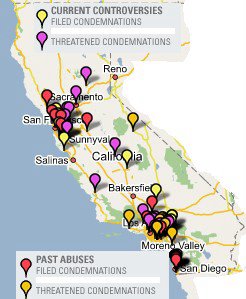
The Institute for Justice has announced a new website for their Castle Coalition project to fight eminent domain abuse at the state and local level whereever possible. You can join the Castle Coalition for free. (But why not donate too?) They promise to send regular updates about efforts to combat eminent domain abuse, and tell you about opportunities in your area to fight the land grabbers.

Their web site has information on what to do if you are threatened with Eminent Domain ("we'll only use it as a last resort" is a threat to take your land if you don't agree to their price), where eminent domain cases are active around the nation.

They also have a google map showing where abuses, threats, and events are taking place. Here's the map showing just California. There's a lot going on right here that we could help with. The rest of the country has plenty of reasons to fight back as well.

Filed in:

Monday, January 23, 2006

How to Publish Your PodCast

I listen to podcasts (Real Estate, Science Fiction, Science, Blarney, economics), but have no desire to make my own. But I'd like to listen to The Real Estate Guys radio show more, and they already upload MP3s of their shows to the web. When I told Robert Helms on the Investor Summit at Sea cruise, that it would be a tiny increment over the work they already do to turn the show into a podCast, he asked me to send instructions.

I did a little bit of research, and discovered that most of the how-to articles on PodCasting focus on how to record your show. Since The Real Esate Guys are already recording, they need only the rest of the instructions. Here are the references I found that looked likely to be the most useful.

I hope that's useful to other people as well.

Filed in:

Monday, January 02, 2006

Steven Brust: The Paths of the Dead

Steven Brust's The Paths of the Dead looks likely to be a pivotal story in the chronicles of the Dragaeran Empire. Some new characters and some old characters are involved in an attempt to revive the empire, and of course intervention by gods and demigods ensues. It's a good adventure, and I (mostly) like the way Brust tells it. Like a couple of others of his recent stories, Brust has chosen a particularly wordy style for this story. In the Vlad Taltos stories that introduced this universe, Brust showed that he can switch writing styles whenever he wants, and that he has a good ear for choosing a style to match the story he wants to tell. Given that skill, I'm not sure why all the conversations in this part of the series are so long winded:

"That was well done," said Orlaan.
"Do you think so?""
"I am certain of it."
"Then I am satisfied."
"Come, sit next to me."
"Very well, you see that I am sitting."
"And are you listening"
"With all of my attention."
"Then I will tell you a story."
"I like stories, if they are good ones."
"I think mine is a good one."
"I will listen, and judge."
"I can ask for no more."
"Begin, then."

Every conversation seems to go this way. "Do you think so?" "I very nearly do." I guess Brust is trying to show that the characters are high born and flowery of speech, but he seems to go beyond what's necessary to make the point.

And somehow the story makes decent progress, with interesting characters being introduced and setting some events into motion that tie back into the main thread later. There's a plausible amount of journeying around with adventures en route. (The Empire was a large place, and it's plausible that when it was replaced with patches of local government many areas would be left unpatrolled and it would take a while for the local citizenry to find a way to enforce order.)

In this story, a coalition of local potentates with expanding realms decides that the portents are right for them to reestablish the empire. That requires a pilgrimage, and of course more adventures. In between episodes, we learn something of the history of Morrolan and other characters we've seen in the Vlad Taltos stories.

Even the sections that seem to be no more than backdrop are interesting and keep up the pace. I didn't pick up on any deep themes or resolutions of important crises in this installment, but I enjoyed reading it nonetheless.

Filed in: